Let us suppose that Dave Chalmers is right about consciousness. If he is then what it is like for me to see red will turn out to be a nonphysical property of my brain. As discussed on the last post Dave thinks that phenomenal consciousness correlates with awareness (which is basically accessibility for him). So where P is the complete physical description of some person, say me, and A is a specification of my being aware of, or having access to, some mental state we will have a conditional of the form (P –> A ) that could, I suppose, be known a priori (in principle). But of course Dave thinks that zombies could have A and lack qualitative consciousness. That is why we need something like the principle of structural coherence to connect facts about awareness with qualitative facts. This gives us the conditional (A –> Q) where Q are the usual qualitative facts. These two conditionals collapse to give us (P –> Q). So for the dualist we can in principle deduce qualitative facts from the physical facts via a theory of consciousness (i.e. via the fundamental principles) a priori. But if (P –> Q) is a priori then physicalism is true. One might object that (P –> A) is knowable a priori but (A –> Q) is not since we need to introspect in order to acquire the concepts in Q. But as long as introspection only provides the concepts and does not play a role in the justification of the deduction it is still (in principle) a priori. So Dave isn’t right about consciousness.
Author: Richard Brown
More on Identity
In his 2004 paper How Can we Construct a Science of Consciousness? Dave Chalmers says,
Where there is systematic covariation between two classes of data, we can expect systematic principles to underlie and explain the covariation. In the case of consciousness, we can expect systematic bridging principles to underlie and explain the covariation between third-person data and first-person data. A theory of consciousness will ultimately be a theory of these principles…
In the third-person facts are all of the functional characterizations typically appealed to by the Lewisian. In the first-person data we find such things as that blue is more like purple than it is like orange and that pain has a certain phenomenal feel, etc. What kind of fundamental principles can we expect? Chalmers gives us a couple of examples in his Facing Up to the Problem of Consciousness. First he postulates “the principle of structural coherence” which he characterizes as;
This is a principle of coherence between the structure of consciousness and the structure of awareness. Recall that “awareness” was used earlier to refer to the various functional phenomena that are associated with consciousness. I am now using it to refer to a somewhat more specific process in the cognitive underpinnings of experience. In particular, the contents of awareness are to be understood as those information contents that are accessible to central systems, and brought to bear in a widespread way in the control of behavior.
In short, then, phenomenal consciousness correlates with what states we access or are aware of ourselves as being in. The second principle is that of “functional invariance” which he characterizes as follows;
This principle states that any two systems with the same fine-grained functional organization will have qualitatively identical experiences. If the causal patterns of neural organization were duplicated in silicon, for example, with a silicon chip for every neuron and the same patterns of interaction, then the same experiences would arise.
These principles are not fundamental but can be explained by some more basic principle and here Chamers offers the dual aspect of information principle;
This leads to a natural hypothesis: that information (or at least some information) has two basic aspects, a physical aspect and a phenomenal aspect. This has the status of a basic principle that might underlie and explain the emergence of experience from the physical. Experience arises by virtue of its status as one aspect of information, when the other aspect is found embodied in physical processing.
At this point one may wonder why we shouldn’t identify the phenomenal properties with the physical properties…Chalmers, in the 2004 paper, says this;
…What would this entail about the relationship between physical processes and consciousness? The existence of such principles is compatible with different philosophical views. One might regard the principles as laws connecting two fundamentally different domains (Descartes 1641/1996; Popper and Eccles 1977). One might regard them as laws connecting two aspects of the same thing (Lockwood 1989; Chalmers 1996). Or one might regard them as grounding an identification between properties of consciousness and physical properties (Smart 1959; Papineau 2002). Such principles could also be combined with different views of the causal relation between physical processes and consciousness (see Chalmers 2002).
So Dave does acknowledge that one might take these correlations to ground an identity claim. Interestingly he seems to take the way that the identity claim will be established as via thinking about parsimony. I suppose that Ned will argue that asserting the identity allows for explanations that we would not have otherwise. Both of these seem like fine reasons to posit the identity. What will the 2-D theorist say? it seems to me that the principle of structural coherence is exactly what gives us the functional foothold that we need to identify the biological basis of experience. What we need then is to determine whether the principle of structural coherence gives us any reason to think that some kind of higher-order theory is right.
UPDATE: It just occurred to me one might use the above kind of considerations to argue that Maria will be able to make the deductions from P to Q (and vice versa) a priori…if so then that would be an independent argument for the identity of the two sets of properties.
The Identity Theory in 2-D
I plan on writing a series of posts discussing various themes that came up in discussion at the online consciousness conference.
I have long been a type-type identity theorist. There was a time when I thought that I would write my dissertation defending a version of identity theory (in fact the very first talk I gave at a professional meeting was what I thought of as a ‘pre-prospectus’ available here: Saying “I Do” to Identity. I presented this as a poster at the ASSC in Antwerp and as a talk at the SPP in Barcelona (I called this my “European Identity Tour”))…When I approached Michael Devitt about the idea he said that people used to be interested in the identity theory but that people had moved on…it turns out that people are getting re-interested in the identity theory in the wake of work by people like Tom Polger, Chris Hill, and Ned Block. One thing that came out very clearly in the discussion is the difference between the identity theory that Block holds from the kind that I hold. The main difference concerns how we will eventually come to discover the mind-brain identities. Broadly speaking there are two different camps.
It is useful to remind ourselves of what the originators of the identity theory held. In “Is Consciousness a Brain Process?” U. T. Place says,
The answer seems to be that we treat the two sets of observations as observations of the same event in those cases where the technical scientific observations set in the context of the appropriate body of scientific theory provide an explanation of the observation of the man in the street. Thus we conclude that lightning is nothing more than a motion of electric charges, because we know that a motion of electric charges through the atmosphere, such as occurs when lightning is reported, gives rise to the visual stimulation which would lead an observer to report a flash of lightning (p. 58 in Chalmers 2002)
J.J.C. Smart in “sensations and Brain Processes” writes,
Why do I wish to resist [the suggestion that qualia are irreducibly psychial]? Mainly because fo Occam’s razor. It seems to me that science is increasingly giving us a viewpoint whereby organisms are able to be seen as psyico-chemical mecanisms: it seems that even the behavior of man himself will one day be explicable in mechanistic terms…That everything should be explicable in terms of physics (together of course with the descriptions of the ways in which the parts are put together –roughly, biology is to physics as radio-engineering is to electro-magnetism) except the occurrence of sensations seems to me to be frankly unbelievable. Such sensations would be “nomological danglers,” to use Feigl’s expression
We can see here an emphasis on the notions of explanation and parsimony. 16 years later David Lewis and David Armstrong establish the alternative camp. Lewis puts it most clearly when he writes,
Psychophysical identity theorists often say that the identifications they anticipate between mental and neural states are essentially like various uncontroversial theoretical identifications: the identification of water with H2O, of light with electromagnetic radiation, and so on. Such theoretical identifications are usually described as pieces of voluntary theorizing as follows. Theoretical advances make it possible to simplfy total science by positing brdge laws identifying some of the entities discussed in one theory with entities discussed in another theory. In the name of parsimony, we posit those bridge laws forthwith. Identifications are made, not found.
In ‘An Argument for teh Identity Theory,” I claimed that this was a bad picture of psychophysical identification, since a suitable physiological theory could imply psychophysical identites –not merely make it reasonable to posit them for the sake of parsimony. The implication was as follows:
Mental state M=the occupant of causal role R (definition of M)
Neural state N=the occupant of causal role R (by the physiological theory)
Therefore Mental state M=neural state N (by transitivity of =)
Nor is this peculiar to psychophysical identifications. He goes on,
…the usual account is, I claim, wrong; theoretical identifications in general are implied by the theories that make them possible –not posited independantly. This follows from a general hypothesis about the meaning of theoretical terms: that they are definable functionally, by reference to causal roles (Psychophysical and Theoretical Identifications)
In a recent paper on functional reduction Ned Block targets the Lewisian view in favor of the Place/Smart view. Here is what he says,
If we want to know why water = H2O, freezing = molecular lattice formation, heat = molecular kinetic energy, temperature = mean molecular kinetic energy, etc, we have to start with the fact that water, temperature, heat, freezing and other magnitudes form a family of causally inter-related “macro” properties. This macro family is mirrored by a family of “micro” properties: H2O, mean molecular kinetic energy, molecular kinetic energy and formation of a lattice of H2O molecules. (Of course a given level can be micro with respect to one level, macro with respect to another.) The key fact is that the causal and explanatory relations among the macro properties can be explained if we suppose that the following relations hold between the families: that water = H2O, temperature = mean molecular kinetic energy, heat = molecular kinetic energy and freezing = lattice formation. For example, why does decreasing the temperature of water cause it to freeze? Why does ice float on water? Here is a sketch of the explanation: The oxygen atom in the H2O molecule has two pairs of unmated electrons, which attract the hydrogen atoms on other H2O molecules. When the kinetic energy of the molecules decreases, (i.e. the temperature decreases) each oxygen atom tends to attract two hydrogen atoms on the ends of two other H2O molecules. When this process is complete, the result is a lattice in which each oxygen atom is attached to four hydrogen atoms.Ice is this lattice and freezing is the formation of such a lattice, which is why decreasing temperature causes water to freeze. Because of the geometry of the bonds, the lattice has an open, less dense structure than amorphously structured H2O (viz., liquid water)–which is why ice (frozen water) floats on liquid water.
Suppose we reject the assumption that temperature is identical to mean molecular kinetic energy in favor of the assumption that temperature is merely correlated with mean molecular kinetic energy? And suppose we reject the claim that freezing is lattice-formation in favor of a correlation thesis. And likewise for water/H2O. Then we would have an explanation for how something that is correlated with decreasing temperature causes something that is correlated with frozen water to float on something correlated with liquid water, which is not all that we want. The reason to think that the identities are true is that assuming them gives us explanations that we would not otherwise have and does not deprive us of explanations that we already have or raise explanatory puzzles that would not otherwise arise. The idea is not that our reason for thinking these identities are true is that it would be convenient if they were true. Rather, it is that assuming that they are true yields the most explanatory overall picture. In other words, the epistemology of theoretical identity is just a special case of inference to the best explanation. (See Block, 1978a; Block, 2002; Block & Stalnaker,1999).
Block goes on to argue that the Lewis style view is incompatible with the metaphysics of physicalism. Block distinguishes between ontology and metaphysics. Ontological physicalism is just the claim that in our ontological commitment to the existence of qualia we commit ourselves only to physical entities (ontological dualists deny this). Metaphysical physicalism is the claim that qualitative properties are essentially or metaphysically physical. That is to say that all qualitative properties will share the same physical properties in so far as they are physical. the Lewis style physicalism is ontologically but nit metaphysically physicalist. This is because as it happens all of the realizers of mental states are physical but metaphysically pain is a functional state for Lewis and only contingently a physical state. Metaphysical physicalism –real physicalism in Block’s view– says that it is not contingent but necessary that pain is a physical state.
But if we adopt the 2-D framework and put the Lewisian claims in terms of it this is no longer a problem. On this kind of view the functional definition gives us the primary intension of ‘pain’ and the physical state gives us the secondary intension. This allows us to treat ‘pain’ just as we do ‘water’. ‘Water is H2O’ has a contingent primary intension and a necessary secondary intension. So we can update Lewis view that ‘pain’ isn’t a rigid designator as the claim that the primary intension of pain is contingent (just like ‘water’). ‘Pain’ is still a rigid designator in the ordinary sense that its secondary intension is necessary. In all worlds considered as counter-factual pain is a brain state. However we accommodate the conceivability of Martians and disembodied minds by noting that in some worlds considered as actual pain is not a brain state (just as in some worlds considered as actual water is not H2O). This does not threaten the identity; it is the usual way that theoretical identities work. Notice also that this 2-D identity theory is a metaphysical physicalism in Block’s sense and not merely an ontological physicalism.
Of course the real resistance to the 2-D Lewisian identity theory is that qualitative states are not supposed to be functionally definable. In fact Block and Chalmers often talk as though qualitative properties are definable as ‘the not functionally definable properties of experience’ (more on that later). If that is your view then you cannot do the Lewsian deduction of the identity. What are we to make of this? I will come back to this in the next post.
HOT Damn it’s a HO Down-Showdown
I have not been too good keeping up with the NYU Mind and Language Seminar like I had originally planned. Part of the problem was the Online Consciousness Conference (about which more later) the other part of the problem has been that I teach until 3:30 and the sessions start at 4:00. At any rate I managed to make it down yesterday for David Rosenthal’s session on his “Sensory Qualities, Consciousness and Perception” which was very interesting.
The commentary by Ned Block focused on the usual issues that he has with HOTheads (i.e. eitology ad hoc, the mismatch problem, etc) though there was an interesting new objection (at least I hadn’t heard Ned give it before). The mismatch problem (red first-order state/green HOT) presents the HOThead with a dilemma. Either what it is like for the person is like seeing red in which case HOT is false or it is like seeing green in which case there is no difference between having an experience and thinking that one has the experience. It is not clear why the second horn of the dilemma is supposed to be bad. If HOT theory is right then having the conscious experience os seeing blue will consist in having the appropriate HOT so the horn just restates the theory.
But building on this Block quotes this passage from pages 185 in Consciousness and Mind:
HOTs do no transfer the property of being conscious from themselves to their targets; indeed, they don’t induce any change whatever in those targets. Rather, they make their targets conscious because a state’s being conscious consists simply in one’s being conscious of oneself as being in that state, and having a HOT is the right way of being conscious of oneself as being in a state.
Block then argued that in the case of the empty HOT –that is where one has a HOT that one is seeing green but has no first-order state at all– there is a conscious mental state that one is not conscious of and so we have a counter-example to the transitivity principle. Block seemed to be suggesting that if we take the above quote seriously then the HOT itself is the conscious mental state and since there is no 3rd-order thought about the HOT it is itself is a counter-example to the transitivity principle or he would need to adopt the same-order view. Rosenthal replied that the HOT was not the conscious state; it was the seeing of blue that was the conscious mental state even though it was a notional state (a lot of this came up at the online conference in Pete’s excellent session). Jesse asked what the NCC of the conscious state would be in this case. It surely doesn’t seem like one can have a NCC for a notional state! This prompted Stephen Stich to exclaim that David was “worse than a dualist”. Uriah interjected that it was a commonplace of predicate calculus that if A is F then it follows that there is a x such that x is F and this entails that if one has a conscious mental state then there is a state that has that property. David objected to this because he thinks that the conscious mental states are states of the person not individual metal states. During the discussion I asked David to return to Ned’s objection because I wasn’t sure what his answer to it was. If the quoted passage is correct then a conscious mental state is identical to having the suitable HOT. What reason does David have to deny that the HOT is thereby the conscious mental state? His answer was that he did not stand by the quoted passage, which seemed really odd to me. I hope to follow up with him about this…
Another very interesting theme of the discussion of how repression works. Someone in teh audience (a nyu student named Lisa, I think) pointed to cases of repression as a possible counter-example to the transitivity principle. When one represses some thought one has to have (unconscious) knowledge of the thought that one is suppressing, which sounds like a HOT, yet the repressed thought is not thereby made conscious. David objected that this was not the way he understood repression to work. Rather than having a HOT usually what happens is that one has unconscious guilt about the repressed thought that leads to repressing it. Ned and David argued a bit about the right way that actual Fruedians talk about repression…no consensus was reached except in so far as David acknowledge that if repression worked in the way that Ned and Lisa suggested then that would be a counter-example to the transitivity principle.
Another audience member (Eric) tried to press this line of attack using the implicit racism test. The idea was supposed to be that after one has taken this test and discovered that one has unconscious racist attitudes one can have the thought that one is having a racist thought with the thought not thereby becoming conscious. David at first denied this and maintained that the thought would be conscious but then he reconsidered and said that attitudes were dispositions and those aren’t mental states.
The session ended with a discussion of the relation between Jesse’s AIR theory and HOT theory (it was pointed out that Dave Chalmers is now calling CUNY the HOT AIR department). David gave his signature argument against attention being necessary for consciousness. in parafoveal vision the percepts at the periphery are conscious even if one is fixating and attending to some central point. This is a case of conscious experience without attention. Jesse’s trademarked response is that attention can be spread over the entire scene to which David responds that at that point he doesn’t know what attention is anymore. At that point the session ended.
Afterwards I asked Jesse if he thought that when we attended to something we became conscious of that thing. He said that he did. I then said that if that was the case AIR theory is an implementation of the transitivity principle and so is not really in competition with David’s view. Jesse agreed that this was the case. I then suggested that we could think of the situation like this: David has argued that there are only two ways that we can become conscious of something: we either sense it or we think about it in the right way. He therefore sees only HOT and HOP. We can then see a lot of Jesse’s work as arguing that there is a third way that we become conscious of something; by attending to it. He agreed…I knew it!
Video Podcasts of my Talks
I will be presenting Deprioritizing the A Priori Arguments against Physicalism at Columbia University tonight as a guest lecture in Hakwan Lau’s seminar on consciousness (other guest lecturers include Uriah Kriegel, David Rosenthal, & Jessee Prinz). I have made a podcast of the talk (a video) available here.
Online Consciousness Conference in its Second Week
The online consciousness conference lasts until March 5th so there is plenty of time to get in on the action. This year’s conference has been very active. So far in just the first week of the conference we have had as many hits as we did for the entire two weeks of last year’s conference! The individual sessions have so far been very active as well with over 200 comments posted thus far. It’s not too late to get in on thh action!
Consciousness, Consciousness & More Consciousness!!
I have talked about the higher-order thought theory of consciousness and introspection before (here). Yesterday I attended a talk by David Rosenthal and he briefly mentioned something about introspection that got me thinking anew about these issues.
Rosenthal was going through the basics of the higher-order theory and was at the part where he explains why it is that we do not find higher-order thoughts in our conscious experience. The higher-order thoughts are seldom themselves conscious. That is to say that usually it is the case that we just have the higher-order thoughts but not third-order thought about that 2nd order higher-order thought. This is what happens in introspection according to Rosenthal. It is difficult, but with training/practice we can become conscious of the HOTS. Which we can represent as follows;
(3) {I, MYSELF, THINK THAT I, MYSELF, THINK THAT I SEE RED}
/
(2) {I, MYSELF, THINK THAT I SEE RED}
/
(1) [RED*]
Here [X*] is used to stand for the first-order sensory qualities that represent the perceptible properties (non-intentionally) and via which we become conscious of those perceptible properties. {X} is used to stand for the higher-order intentional states that represent the first-order sensory states (and N-order intentional state of course) and via which we become conscious of the first-order sensory states. So when (2) occurs I am conscious of myself as seeing red and so I will be consciously seeing red. In the rare cases where (3) occurs I will be introspecting my conscious experience, which is a peculiar and unnatural thing to do. Now I have always wondered what it is supposed to be like for the person who has (3) according to the HOTT theory. Rosenthal himself says that when we introspect there is no new quality that enters into our experience so that when we introspect we just become conscious of the first-order state in an attentive, reflexive way. This is what led to my Introspective HOT Zombie problem which I previously talked about.
So, yesterday I asked whether he thought we could ever introspect the higher-order thought itself. Is it possible for us to become introspectively aware of the higher-order thought? He said no because we would then need to have a fourth-order thought like (4)
(4) {I, MYSELF, THINK THAT I, MYSELF, THINK THAT I, MYSELF, THINK THAT I SEE RED}
This surprised me a bit because I had been thinking that when (3) occurred one was introspecting the higher-order thought. What came out of the conversation was that when one has (3) when is unconsciously conscious of the higher-order thought. Just like when I am consciously seeing red (i.e. when I have (2)) my HOT is not conscious so too when I introspect my introspecting HOT is not conscious. His response seems to be that in this case I am not consciously introspecting (consciously introspecting means having (4) which Rosenthal denies that we can do).
But this doesn’t seem right to me. When I have (2) what it is like for me is how the HOT specifies it; i.e. it is like seeing red for me. So when I have (3) shouldn’t it also be the case that the what it is like for me is how the HOT specifies it? If so then it would seem to be the case that it should be like thinking that I am conscious of red. If so then I should be able to have a version of (3) that “focuses” on the thinking part in which case I would be introspecting the HOT itself. This fits more with what Rosenthal actually says about introspection (see the above linked post).
Oh yeah, and the Online Consciousness Conference has begun!!
The Phenomenal Qualities Project Podcasts
via Sam Coleman;
*The Phenomenal Qualities Project*
Podcasts now available on the Project website-
Featuring:
Tim Crane, David Papineau, Philip Goff
Jerry Valberg, Andreas Hutteman, Sam Coleman
on such topics as:
The nature of phenomenal concepts, perception,
consciousness and metaphysics, intentionalism,
qualia, physicalism.
Podcasts available at:
See also our uploaded papers, and photos from recent events.
—
-The Phenomenal Qualities Project is funded by the AHRC-
http://phenomenalqualities.wordpress.com/
For more information, or to join our mailing list
please contact Sam Coleman (S.Coleman@herts.ac.uk)
Attention and Mental Paint
(cross-posted at Brains)
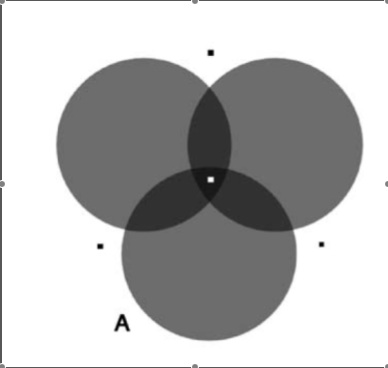
The NYU Mind and Language seminar has started up again with a really excellent line up. Last Tuesday I attended Ned Block’s session on his paper Attention and Mental Paint. I have seen a version of this before. The basic idea comes from figures like figure a below. if one fixates (stares) ate the center and, while keeping one’s gaze fixed, moves one’s attention to an individual disk that disk will appear DARKER. After a bit of practice one can DARKEN any disk one wants by moving one’s attention around. Go ahead, give it a try!
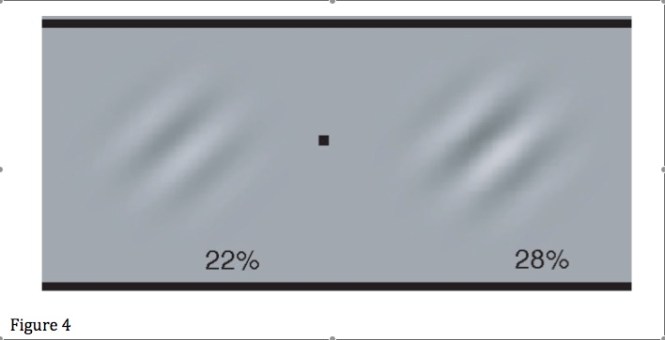
Recently a psychologist, Marisa Carrasco, has run experiments trying to quantify this effect. Below is a reproduction of the stimulus. Here the two patches differ in contrast by 8% yet when one fixates on the center and attends to the 22% patch one will judge it to be the same contrast as the 28% patch.
Block wants to use these findings as the basis for an argument against both direct realism and representationism. The basic argument goes as follows.
- First we focus only on two cases. The first case is when we fixate and attend to the center. In that condition subjects get the judgment about contrast right (i.e. they judge that the left patch is lower in contrast). In the second condition we fixate on the center but attend to the left patch. In that condition people get the judgment incorrect (i.e. they judge the two patches to be the same contrast.
- The second step is his claim that there is no reason to think that either of the two cases above are illusionary. Both are veridical.
- If both experiences are veridical then the thing that they are experiences of must differ in some property but all of the properties of the objects are the same. The only thing that has changed is that one has moved one’s attention from center to right.
- Therefore there must be mental paint, or non-representational features to our experience (the anti-representational conclusion) or a mental aspect of mental experience (the anti-direct realism conclusion)
a lot of the discussion at the session focused on whether or not there was an illusion at work here. Block claims that in both cases talked about above the perception is veridical. Why? His idea is that both of the experiences play the same functional role and so are accurate. The pro-illusion folk (Jesse Prinz was in this camp) argued that when you attend to something you represent that thing more veridically and so the condition where one fixates and attends to the center is illusionary (Jesse preferred ‘distorted’). Block protested that one could just as well say that attention distorted, or magnified, the scene and so the fact that one has access to more information when one attends is not by itself an argument that the experience is more veridical. Some other issues came up about various responses direct realists or representationalism could make.
However, I am less interested in that issue as I am in the issue of whether there is an argument here against anything like the kind of higher-order thought theory that I am fond of (i.e. one very much like David Rosenthal’s). On this kind of view we have two distinct kind of mental representations. At the first-order level we have the mental states that represent the sensible qualities. So, when I am seeing red I am in a mental state that has a property, call it red*, the represents physical red. However the kind of representation that is going one here is not intentional or conceptual. It is homomorphic. Red* is the property which is related to green* and pink* in a way that mirrors the relations between physical red, physical green, and physical pink. The starred properties can occur both consciously and unconsciously. When they occur unconsciously there is nothing that it is like for the organism in which they occur. They become conscious when I am aware of myself as being in a red* state. According to Rosenthal I do this by having a thought which deploys the concepts Red. So on this view the higher-order thought is representational in the traditional sense and it is the thing which is responsible for the phenomenology of the experience.
So is there mental pain on this view? Well, as long as one agrees that there can be unconscious sensory states with no phenomenology (a big step!) then Rosenthal’s first-order sensory qualities will count as mental paint. They are not intentional and they are mental. But they do not play a role in determining the phenomenology (except in the sense that we get the concepts we deploy in the higher-order thought from them) and so if we restrict ourselves only to conscious experiences it does look like Rosenthal denies the existence of mental paint. A conscious experience of red is constituted by a ‘I am seeing red’ thought which is completely intentional/representational. So then does Ned’s argument cut any ice against Rosenthal’s account of conscious experience?
It is not clear that it does. Ned’s argument gets its force from the claim that the thing being represented would have to be different because all conscious experiences are or represent just the actual properties that the object actually has. But on Rosenthal’s view we have the first and second order mental states. So, one could hold that there is some change in the first-order representation of the two patches or one could hold that the first-order representations are the same in the two cases and what changes is the way in which we are conscious of them. In talking briefly about this with David he seems to think that attention changes the first-order state whereas I seemed to think it was teh content of the higher-order state which changed. But since we are talking about conscious experiences here and it is the higher-order state that accounts for the conscious phenomenology the difference has to be in the way that we are conscious of the patch in the two cases…this may be because of attention in a causal sense but it is the content of the higher-order state that has to account for the difference in the phenomenology.
C02 Program Finalized
Well, I finally got my computer back. Sadly the hard drive was so messed up that I was totally unable to recover any data. I lost a couple of papers that I was working on and ALL of the photos from my honeymoon so I am not happy about that. …at any rate the program for the Second Annual Online Consciousness Conference is now finalized (I have been putting this together from my iphone for the last few weeks if you can believe it!) check it out and spread the word!
 Richard Brown