I Refute You Thusly

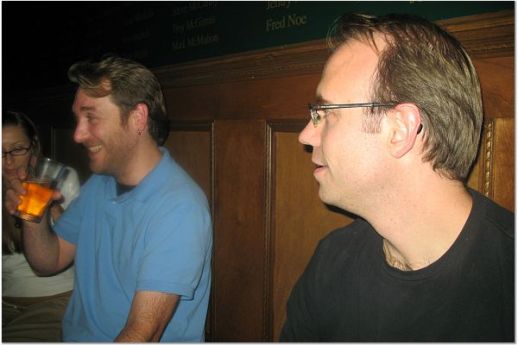
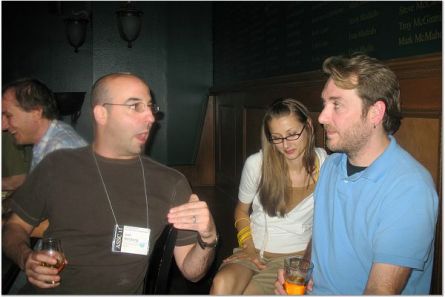
Courtesy of Jared Blank, I got some photos from the ASSC in Vegas this summer. Here are some of me and Josh Weisberg that tell the story of philosophy through the ages…ahh…Vegas, baby 

A Refutation in Three Acts;

Guys talk girl board

Act 1: I listen to Josh’s case, hmm, yes, consciousness you say?…Jennifer looks bored….she is sooo into consciousness…

wwwww

Act 2: Well, I’ve listend and I just don’t see it working out…Josh is clearly intuition mongering at this point…Jennifer’s still bored…

me

QED.  Roblin thinks I’m crazy…Jennifer?

jared 

Thanks Jared (right, with Josh being licked by Dave Biesecker)

Does God Know About Quantuum Mechanics?

I was answering a comment from Richard C. which made me think of this.

It has been established via experiment that Einstein was wrong and that randomness is a fundamental feature of the quantuum mechanical description of reality. Scientists are even now using entaglement in the lab to ‘teleport’ information (in the form of transfering states fromone entangled atom to the other) inthe hopes of making this suprising fact about nature useful (relativity physics has never even come close to being so useful!). The question, then, is can an omniscient being know in advance the outcome of the random quantuum events? Either way you answer there is trouble.

If you say that God cannot know the outcome of the events then there is an obvious limitation of God’s knowledge. With respect to quantuum mechanics He can do no better than us! He knows the outcome of the events in the form of probabilities, but just like us He is unable to say in any given case what the outcome will be. But the Quantuum Mechanics is surely the greatest discovery in the history of the universe! For, if this is true then we have discovered God’s knowedge of the universe…but this sounds crazy! So it seems to me that there is strong pressure to say that God does indeed know the outcome, in advance, of all quantuum events.

But then there is a seperate problem. Forget for the moment the issue of whether His foreknowledge is compatible with the outcome being truely random and consider the double slit experiment (I assume you know what that is, if not let me know and I’ll give a description). One of the strangest things that we have found out about it over the last thirty years or so is that if there is a way for us to know the path that the photon actually takes, and so determine which slit it actually travels through, then the interference pattern no longer manifests. What we get is ‘nothing but us particles down hir sir’. In Green’s book The Fabric of the Cosmos he details experiemnts he calls ‘quantuum erasures’ where they showed that what matters is whether someone could know the path taken by the photon. Tis is obviously extremely strange and anti-common sense, but it is a robust experimental finding. But now consider God. If He knows the path that the photon takes then it will not act like a wave. It will act like a particle. So from God’s point of view particle physics has to be correct. Since He is always holding the door of the refrigerator open, metaphorically speaking, the light inside will always be on. But this really reduces to the first option in claiming that God can’t have any direct knowledge of quantuum physics.

In fact one might think that if God did in fact exist then we couldn’t have discovered quamntuum mechanics in the first place.  

Devitt on the A Priori

So I have been reading Devitt’s paper “No Place for the A Priori” where he lays out his case against a prori knowledge. His claim is that there is only one way of knowing, and that is the empirical way. His strategy in the paper is to first argue that the kinds of knowledge that people usually claim to be examples of the a priori (i.e. math, logic, and philosophy) can all be explained on the emprical model. This means that there are two options for how we come to have knowledge of (say) the logical truths and so we would then need to see if each option is equally viable. This lead him to the second part of his strategy, which is to argue that the notion of a priori knowledge is so mysterious and obscure that the relatively well worked out empirical model is to be preferred. He even goes so far as to suggest that if he is right, “it is not rational to believe in the a priori.” Oh irony of ironies!

What then is the empirical model? He says,

An answer starts from the metaphysical assumption that the worldly fact that p would make the belief that p true. The empirical justification of the belief is then to be found in its relationship to experiences that the worldly fact would cause. Justified beliefs are produced and/or sustained by experiences in a way that is appropriately sensitive to the way the world is. This is very brief and we shall return to the question later. Still it is hard to say much more.

So the empirical model looks like it boils down to the correspondance theory of truth. There is though a lot more to say. For instance ‘worldly fact that p’ is ambiguous as between (in Armstrong’s sense) a world of states of affairs (or, in Russell’s older terms ‘facts’), and a world of things. But we can leave that aside. His main claim is that even this sketchy characterization of the empirical model is more worked out than any account of a priori knowledge and can also account for our knowledge that seems to us a priori (math, logic, etc).  

Now I am generally sympathetic to this claim, being a naturalist myself, but the way that he puts it certainly seems acceptable to some ‘a-prioraphiles’. Might not it be the case that the ‘worldly fact’ that modus ponens is a valid logical form play the kind of role that p does in the characterization above? Rational intuition is often characterized as a kind of ‘grasping’ with the mind. It is an intellectual kind of experience where one sees or appreciates some necessary fact about reality. Thus my beliefs about modus ponens would be ‘appropriately sensitive to the way the world is’. Of course, one couldn’t be a physicalist (like I am), again in Armstrong’s sense, but one could still be a naturalist…Or is that the a-priorafile can’t allow that modus ponens is a non-physical natural phenomena (i.e. a worldly phenomena that exists in space and time)?

CUNY Update

Well, as everyone knows, the new academic year has started…The Graduate Center is really happening this year! I am auditing a class on meaning with Devitt and Neale (newly arrived from Rutgers…) that promises to be very interesting, as well as Kripke’s seminar on the semantics of fictional names…it looks to be basically a re-visiting of his John Locke lectures, which I am looking forward to. He has also said that he might discuss the claim that the ‘de re implies the de dicto’, which I take to mean the Barcan formula, and that is especially interesting to me…. 

There is other faculty news at The Graduate Center…I have heard rumors that Strawson is indeed leaving, and so we will have to replace him. They have had trouble filling this position (when I first came it was held by Martin Davies, who went to Oxford). I doubt that they will find anyone before I leave (fingers crossed ;^))…I get the feeling that something is in the works, but I am out of the loop on this one. I also hear rumors that, on a new line, we hired Graham Priest (& didn’t hire him :)) Finally there is the Kripke Institute, which they hired Alan Berger to run. I am really looking forward to seeing what is going to happen with that…one thing that I have been thinking about is a conference on the intersection of Kripke’s work and consciousness studies…a man can dream can’t he?

For anyone who is in the New York area (or plans to be) The Graduate Center has its Fall colloquium schedule up, which looks fantastic! The colloquiums are Wednesday afternoon 4:15-6:15 and all are welcome (wine/cheese/dinner afterwards).

There is also the CUNY Cognitive Science Symposium and Discussion Group which runs Fridays from 1-3 which also looks good (drinks afterwards). David (Rosenthal) is on sabbatical this academic year, but he says he will be around as much as he can…again, all are welcome.

Right Thing, Wrong Reasons

Suppose that there is some theory of ethics that, though not the correct theory, nonetheless results in the people who follow it sincerely performing actions that, as it happens, are the ones that the correct moral theory prescribe.

To give an example. Suoppose that Kant is right that an action performed for any reason beside the conscious recognition of ones’ duty is not a morally praiseworthy action. Now suppose that there is this other theory (Mill thought it was utilitarianism, but it may be any other theory that you like besides Kant’s…say a virtue theory, or a Divine Command theory, or a Rawlsian theory….doesn’t matter…) that in each case makes the same prediction as the Categorical Imperative.  Suppose further that someone who follows this theory, though acting for some reason other than duty, nonetheless in each case does the action that is perfectly consistent with duty (in Kant’s terms).

Is it the case that this person performs no morally praiseworthy actions? I am inclined to say that these actions are morally good and so, in some cases, Kant can’t be right that the only critereon for an actions rightness is whether it is motivated by duty.

Now, an interesting question (to me) is whether or not I can consitently will this kind of world; that is whether or not the maxim that explicitly mention that the actor is not acting from duty pass the test of teh Categorical Imperative. It seems to me, prima facie, that I can consistently will the kind of world I described above…but I can see where there might be objections.

First, one might object that given Kan’ts view about rationality and acting freely that the people in the world I described would not be acting freely and so can’t be acting morally. But in the most general sense these people do seem to be acting in a Kantian kind of way. Their will’s are determined by a law of their own choosing. But even if one can’y stand this way of putting it, their are other notions of freedom of the will underwhich these people are acting free, and, lest we forget, there are those inspired by Frankfurnt (I am not one of them) who think that being free doesn’t have very much to do with being morally blameworthy/praiseworthy.

Second, one might object that these poeple don’t know the correct moral theory and so don’t know that they are acting morally. Since they don’t know that they are acting morally it isn’t possible that they are. If this is right then perhaps the world I described is a kind of moral Gettier case…that might be interesting….but what is it that is supposed to be controdictory about doing the right thing without knowing that you are?

Re-Inventing the Wheel

In discussing the ideas of the previous post with a colleague (Chris Steinsvold) I found out that I had basically re-discovered (a simple kind) of hybrid logic. Here is a nice introductory paper by Patrick Blackburn aptly subtitled ‘A Hybrid Logic Manifesto’….there is even a hybrid logic website! (where, incidently, I got the paper from…there are all kinds of papers there!)

The basic idea behind hybrid logic is that you first add new constants, called nominals and usually represented by i, j, k,… which are supposed to ‘denote’ or name particular worlds, instants, or whatever is required by the modality one is working in. One then introduces the ‘@’ operator, with a nominal subscript. So, @ip says that p is true at the world/instant/whatever that the nominal i denotes.

So, the ‘@’ operator that I introduced ( v(@a,w)=T iff (a, actual world)=T and v(~@a,w)=T iff (~a, actual world)=T) can be understood as the standard ‘@’ of hybrid logic where the nominal is the actual world and so assumed. To keep things simple I think I will change this @ with the assumed actual world nominal to ‘Θ’ this will give me a three operator modal logic [] (true at all possible worlds), ◊ (true at some possible world), and Θ (true at the actual world)…One reason to do this is that I am still not sure whether @ip means that p is true ONLY at i…that might be acceptable for tense logics but I wouldn’t want to take that to be true for Θp…this just says that p is true at the actual world, whether it is true at other possible worlds doesn’t seem to matter too much for the purposes that I want to use it for.

Then the ‘simpler’ proof that God’s omniscience is incompatible with my free will that I gave in the comments of the previous post can be put as follows

1. ΘB(k,a)
(assume that God actually knows beforehand what I will do)

2. Θa    (from 1)
(if He actually knows beforehand that a, then a is true at the actual world)

3. Θa –> []Θa
(if a actually happens, then it is true in all possible worlds that a happens in the actual world)

4. []Θa (2,3 MP)
5. ΘB(k,a) –> []Θa   (1-4 CP)
(if God actually knows what I will do before I do it then it is necessary that I do it in the actual world)

So, standard modal logic is not expressive enough to capture the intuition that God’s foreknowledge is incompatible with Human free will. We need to move to hybrid logic to do so…but this isn’t worrisome, since Blackburn shows (in the above linked paper) how we can translate any hybrid logical formula into standard first-order logic…

Third Time’s the Charm (or: This Time I Really Got It!!!)

OK, so I am basically obsessed with this stuff about God’s omniscience and Free Will. I have been having some very interesting, and helpful, discussion about whether Plantinga’s defense, which I take it is the standard defense, of their compatibility is any good or not. I have a sneaking suspicion that the two are incompatible and I have been trying to construct a poof to that effect, with mixed results…but I think I got it this time…if it turns out that I don’t then I promise that I will give up!

It seems to me that the problem is that “If God knows what I will do before I do it then it is necessary that I do it” does not really capture what the person who says that God’s foreknowledge is incompatible with our free will is trying to say. This is because, as we have seen, it must be the case that all my actions are necessary, but this doesn’t sound right at all (however, I do think some people are committed to it).

So, to make it clearer what I am actually trying to say, let me introduce a new modal operator ‘@’  with the following truth condition, where ‘v(x,w)’ is the valuation of x at world w,

v(@a, w)=T iff v(a, actual world)=T

v(~@a,w)=T iff v(a, actual world)=F

this says that @a is true if a is in fact true at the actual world and ~@a is true if a is in fact false at the actual world (~@a<–>@~a) so there is no need to introduce a fourth operator). ‘[]’ and ‘<>’ are given their usual interpretations.

Then I can say that God actually knows before I do a certain action that I will in fact actually do it. To avoid getting involved in tense logic let us introduce a predicate ‘B’ for before (though I think we could define ‘B’ in terms of the standard tense operators F, P, H, and G). Let ‘k’ be ‘God knows that’ and ‘a’ be some action of mine, then I can symbolize ‘God actually knows before I do action a that I will in fact actually do action a’ as @B(k,a), then the proof goes as follows

1. @a & @B(k,a)   (this says that God actually knows what I did before I did it)

2. []@B(k,a) –> []@a  (necessary truth)

3. @a –> []@B(k,a)      (necessary truth)

4. @a       (from 1)

5. []@B(k,a)     (4,3 MP)

6. []@a     (5,2 MP)

7. (@a & @B(k,a)) –> []@a   (1-6 conditional proof)

Since 7 says that if it is the case that I actually do a and God knows beforehand that I actually do a then it is necessary that I actually do a, and God’s actually knowing that I do a entails that I actually do a (7) reduces to

7′ @B(k,a) –> []@a

which says that if God actually knows what I will do beforehand then it is necessary that I actually do it.

Now one may wonder what the difference between ‘a’ and ‘@a’ is. Ordinarily there will be no difference, but there will be a huge difference when we examine the modal properties of the two. []a will be true iff a is true in all possible worlds, whereas []@a will be true if @a is true in all possible worlds, or in other words if it is the case that at every possible world it is true that, in the actual world, I do a. This is why (3) above is a necessary truth but (3′) is not,

(3′) a –> []B(k,a)

(3′) says that if I do a then in every possible world God knows beforehand that I will do a. This can be false because there are possible worlds where the antecedant turns out false because in that world I do not do a and so God does not know it. But (3) can’t be false. For if it were then it would be the case both that I actually do a and that God did not actually know beforehand that I did a, which is just to deny that God is omnicient (so enigman will be happy).

Whew! So, if this is right then God’s foreknowledge is indeed incompatible with my having free will. If not then I will finally have to admit that there is at least one metaphysical interpretation on which it can both be true that God knows what I will do before I do it and that I am free…and I will then actually be very depressed!
What God Doesn’t Know

 So, I have been thinking a lot about Free Will and Omniscience, and though it has been rewarding I am less than happy with the results because I have been convinced that the proof I gave is only valid if one accepts metaphysical ssumptions that I do not accept…drat! I suppose there is some solice in knowing that it can be used to attack people who do hold those metaphysical views…but in the course of thinking about this stuff I came to realize that there are some problems with the claim that God is omnicient…for instance consider (1),

1. God knows that this sentence is false.

If (1) is true then God knows that the sentence is false, but if he knows that it is false then it is false and if it is false He doesn’t know it and so is not omniscient. So if this sentence is true then God is not omniscient. However if the sentence is false then God doesn’t know that the sentence is false and so he is not omnicient.

So God can’t know everything. But one may think that this is only due to the fact that (1) is contradictory and no one can know contradictions…but what about (2),

2.God can’t know that there is something that He doesn’t know

If (2) is true then there is something that God doesn’t know, namely that He doesn’t know something. If the sentence is false, then he can know that there is something that He doesn’t know, and since he knows this, that means that there is something that He doesn’t know and so can’t be omniscient.

hmmm…..