Consciousness & the Tribunal of Experience

Here is a video of a recent talk I gave to the psychology department at Columbia University as part of their Cognitive Lunch speaker series. This rehearsal led to me add a few slides and change a few things here and there but I don’t have time to re-record it. Overall it is ok but I think the actual talk was better done…ah well…

Error
This video doesn’t exist

Download the video in Ogg format or subscribe to my podcast

NyCC Video

Thanks to everyone who came out to the Parkside Lounge last night! It was a weird and wonderful night! For those of you who couldn’t make it here is some video recorded by Jennifer on my iPhone set to our version of Freddie Freeloader…We’ll be back @ the Parkside April 26th and May 31st…Let me know if you are in town!

Error
This video doesn’t exist

Part-Time Zombies

On Friday I attended Michael Pauen‘s Cogsci talk at CUNY.

Pauen wanted to present some thought experiment based arguments that were intended to support a priori physicalism; a project after my own heart! The first involved what he called a part-time zombie. The basic point was to try to present a reductio of the property dualist’s position. For the purposes of the argument Pauen distinguished between experiential privilege and epistemic privilege. Experiential privilege is just the recognition that I have my experiences in a way that you can’t; epistemic privilege is the further claim that I can know about my experiences in some special way (the first-personal way) that it is impossible for you to know (from the third-person). Pauen grants experiential privilege but denies epistemic privilege.The argument goes as follows. Let us suppose, for reductio, that the property dualist is right and that we have some kind of privileged first-person access to our mental states. The second step involved arguing that if we accept the logical possibility of zombies then we must accept the nomological possibility of zombies. If that is the case then consider the following two cases. In one case I am a zombie and so by definition have no phenomenal consciousness. Let us suppose that I am in some functional state that is the pain state minus the nonphysical quale. I have this state and then later reflect on it. In the second case I have the exact same functional state but with the nonphysical quale. I later reflect on it. Can there be any difference in what it is like for me? Pauen argued that there can be no difference unless there is some functional difference and so it turns out that if the dualist is right and we have a special kind of access to our mental states then we are led to the conclusion that we do not have a special kind of access to our mental states. Reductio. This argument is similar to Michal Lynch’s argument presented in “Zombies and the Case of the Phenomenal Pickpocket”.

During discussion I suggested that the property dualist might respond along the lines that Chalmers has responded to the charge that he is an epiphenomenalist, In short his position is that there is a kind of phenomenal belief that we can have that is not demonstrative, not indexical but is rather partly constituted by the phenomenal property itself. So when if I were a part-time zombie then the times during which I was on shift as a zombie would be times when I tokened beliefs that were not full fledged phenomenal beliefs since they were missing the qualitative property. When I am not a zombie my phenomenal beliefs do have the nonphysical qualitative property. So there is a difference, and this difference makes a difference to my inner life but it is not one that I can express. For instance I cannot say, ‘oh now the qualia are back’ since that amounts to a functional difference which we have ruled out in the thought experiment; at both times I am in the very same functional state. So what is the difference then? Well in one case I know that I am in, say, pain and in the other case I don’t but this needn’t require that there be a functional difference. Pauen objected that if it made an epistemic difference then one would have to be able to report or express that knowledge. IF there really were nothing else to it then we could not be sure that we weren’t part-time zombies right now. Maybe 20 minutes ago I was a zombie…It seems to me that there is still a way out of sorts. Perhaps the property dualist cannot rule out with certainty that I was not a zombie 20 minutes ago but she could argue that the probability of it is quite low. So, given that I now know that I am having qualia and given the dualist’s principles like the ones that Chalmers talks about (principle of structural coherence and functional invariance, etc) it is extremely unlikely that there are times when I am a part-timer in zombie land…but I dunno it is hard for me to maintain these intuitions since I am not a property-dualist…

On a different note this connects up to something that I was independently thinking about last week. How can we rule out the possibility that some of us are zombies and some of us aren’t? I talk to people who really seem to honestly be eliminativist about qualia…but how can this be? One possibility may be that they are zombies but I am not. That would be messed up! But how could we know? They say they aren’t; but that’s exactly what zombies say! Call this the Problem of Other Qualia; how does a dualist get out of it? It doesn’t seem as though they will be able to do it without appealing to a link between qualitative properties and functional properties but to do so is to undermine the initial intuition that qualitative properties logically float free of functional properties since in order to even say what they are we need to appeal to functional properties. The property dualist cannot respond the the mixed-zombie hypothesis by arguing that the link between functional and phenomenal is merely nomological because the point of the thought experiment is to show that they seemingly float free at the nomological level as well.

To support the idea that our concept of qualitative properties are really functional he offered another thought experiment based on qualia inversion. Instead of color qualia he focused on pain and pleasure qualia. So imagine two babies that have pain/pleasure inversion. Does it really seem as though this is possible without any functional difference? Could one baby have the feeling that you and I have when we are stabbed in the leg and the other have the feeling that you and I have when we are lightly caressed on the leg without any functional difference, It doesn’t seem that way to me at all! Even if one thought that this was begging the question against the property dualist I still think that this thought experiment is useful because if enough ordinary people agreed with Pauen then that wold seem to cast some doubt on the property dualist’s claim that our ordinary conception of qualia is non-functional (which is where a lot of their argument gets its force).

A Short Argument for Physicalism

Let us suppose that Dave Chalmers is right about consciousness. If he is then what it is like for me to see red will turn out to be a nonphysical property of my brain. As discussed on the last post Dave thinks that phenomenal consciousness correlates with awareness (which is basically accessibility for him). So where P is the complete physical description of some person, say me, and A is a specification of my being aware of, or having access to, some mental state we will have a conditional of the form (P –> A ) that could, I suppose, be known a priori (in principle). But of course Dave thinks that zombies could have A and lack qualitative consciousness. That is why we need something like the principle of structural coherence to connect facts about awareness with qualitative facts. This gives us the conditional (A –> Q) where Q are the usual qualitative facts. These two conditionals collapse to give us (P –> Q). So for the dualist we can in principle deduce qualitative facts from the physical facts via a theory of consciousness (i.e. via the fundamental principles) a priori. But if (P –> Q) is a priori then physicalism is true. One might object that (P –> A) is knowable a priori but (A –> Q) is not since we need to introspect in order to acquire the concepts in Q. But as long as introspection only provides the concepts and does not play a role in the justification of the deduction it is still (in principle) a priori. So Dave isn’t right about consciousness.

HOT Damn it’s a HO Down-Showdown

I have not been too good keeping up with the NYU Mind and Language Seminar like I had originally planned. Part of the problem was the Online Consciousness Conference (about which more later) the other part of the problem has been that I teach until 3:30 and the sessions start at 4:00. At any rate I managed to make it down yesterday for David Rosenthal’s session on his “Sensory Qualities, Consciousness and Perception” which was very interesting.

The commentary by Ned Block focused on the usual issues that he has with HOTheads (i.e. eitology ad hoc, the mismatch problem, etc) though there was an interesting new objection (at least I hadn’t heard Ned give it before). The mismatch problem (red first-order state/green HOT) presents the HOThead with a dilemma. Either what it is like for the person is like seeing red in which case HOT is false or it is like seeing green in which case there is no difference between having an experience and thinking that one has the experience. It is not clear why the second horn of the dilemma is supposed to be bad. If HOT theory is right then having the conscious experience os seeing blue will consist in having the appropriate HOT so the horn just restates the theory.

But building on this Block quotes this passage from pages 185 in Consciousness and Mind:

HOTs do no transfer the property of being conscious from themselves to their targets; indeed, they don’t induce any change whatever in those targets. Rather, they make their targets conscious because a state’s being conscious consists simply in one’s being conscious of oneself as being in that state, and having a HOT is the right way of being conscious of oneself as being in a state.

Block then argued that in the case of the empty HOT –that is where one has a HOT that one is seeing green but has no first-order state at all– there is a conscious mental state that one is not conscious of and so we have a counter-example to the transitivity principle. Block seemed to be suggesting that if we take the above quote seriously then the HOT itself is the conscious mental state and since there is no 3rd-order thought about the HOT it is itself is a counter-example to the transitivity principle or he would need to adopt the same-order view. Rosenthal replied that the HOT was not the conscious state; it was the seeing of blue that was the conscious mental state even though it was a notional state (a lot of this came up at the online conference in Pete’s excellent session). Jesse asked what the NCC of the conscious state would be in this case. It surely doesn’t seem like one can have a NCC for a notional state! This prompted Stephen Stich to exclaim that David was “worse than a dualist”. Uriah interjected that it was a commonplace of predicate calculus that if A is F then it follows that there is a x such that x is F and this entails that if one has a conscious mental state then there is a state that has that property. David objected to this because he thinks that the conscious mental states are states of the person not individual metal states. During the discussion I asked David to return to Ned’s objection because I wasn’t sure what his answer to it was. If the quoted passage is correct then a conscious mental state is identical to having the suitable HOT. What reason does David have to deny that the HOT is thereby the conscious mental state? His answer was that he did not stand by the quoted passage, which seemed really odd to me. I hope to follow up with him about this…

Another very interesting theme of the discussion of how repression works. Someone in teh audience (a nyu student named Lisa, I think) pointed to cases of repression as a possible counter-example to the transitivity principle. When one represses some thought one has to have (unconscious) knowledge of the thought that one is suppressing, which sounds like a HOT, yet the repressed thought is not thereby made conscious. David objected that this was not the way he understood repression to work. Rather than having a HOT usually what happens is that one has unconscious guilt about the repressed thought that leads to repressing it. Ned and David argued a bit about the right way that actual Fruedians talk about repression…no consensus was reached except in so far as David acknowledge that if repression worked in the way that Ned and Lisa suggested then that would be a counter-example to the transitivity principle.

Another audience member (Eric) tried to press this line of attack using the implicit racism test. The idea was supposed to be that after one has taken this test and discovered that one has unconscious racist attitudes one can have the thought that one is having a racist thought with the thought not thereby becoming conscious. David at first denied this and maintained that the thought would be conscious but then he reconsidered and said that attitudes were dispositions and those aren’t mental states.

The session ended with a discussion of the relation between Jesse’s AIR theory and HOT theory (it was pointed out that Dave Chalmers is now calling CUNY the HOT AIR department). David gave his signature argument against attention being necessary for consciousness. in parafoveal vision the percepts at the periphery are conscious even if one is fixating and attending to some central point. This is a case of conscious experience without attention. Jesse’s trademarked response is that attention can be spread over the entire scene to which David responds that at that point he doesn’t know what attention is anymore. At that point the session ended.

Afterwards I asked Jesse if he thought that when we attended to something we became conscious of that thing. He said that he did. I then said that if that was the case AIR theory is an implementation of the transitivity principle and so is not really in competition with David’s view. Jesse agreed that this was the case. I then suggested that we could think of the situation like this: David has argued that there are only two ways that we can become conscious of something: we either sense it or we think about it in the right way. He therefore sees only HOT and HOP. We can then see a lot of Jesse’s work as arguing that there is a third way that we become conscious of something; by attending to it. He agreed…I knew it!

Consciousness, Consciousness & More Consciousness!!

I have talked about the higher-order thought theory of consciousness and introspection before (here). Yesterday I attended a talk by David Rosenthal and he briefly mentioned something about introspection that got me thinking anew about these issues.

Rosenthal was going through the basics of the higher-order theory and was at the part where he explains why it is that we do not find higher-order thoughts in our conscious experience. The higher-order thoughts are seldom themselves conscious. That is to say that usually it is the case that we just have the higher-order thoughts but not third-order thought about that 2nd order higher-order thought. This is what happens in introspection according to Rosenthal. It is difficult, but with training/practice we can become conscious of the HOTS. Which we can represent as follows;

(3) {I, MYSELF, THINK THAT I, MYSELF, THINK THAT I SEE RED}
/
(2) {I, MYSELF, THINK THAT I SEE RED}
/
(1) [RED*]

Here [X*] is used to stand for the first-order sensory qualities that represent the perceptible properties (non-intentionally) and via which we become conscious of those perceptible properties. {X} is used to stand for the higher-order intentional states that represent the first-order sensory states (and N-order intentional state of course) and via which we become conscious of the first-order sensory states. So when (2) occurs I am conscious of myself as seeing red and so I will be consciously seeing red. In the rare cases where (3) occurs I will be introspecting my conscious experience, which is a peculiar and unnatural thing to do. Now I have always wondered what it is supposed to be like for the person who has (3) according to the HOTT theory. Rosenthal himself says that when we introspect there is no new quality that enters into our experience so that when we introspect we just become conscious of the first-order state in an attentive, reflexive way. This is what led to my Introspective HOT Zombie problem which I previously talked about.

So, yesterday I asked whether he thought we could ever introspect the higher-order thought itself. Is it possible for us to become introspectively aware of the higher-order thought? He said no because we would then need to have a fourth-order thought like (4)

(4) {I, MYSELF, THINK THAT I, MYSELF, THINK THAT I, MYSELF, THINK THAT I SEE RED}

This surprised me a bit because I had been thinking that when (3) occurred one was introspecting the higher-order thought. What came out of the conversation was that when one has (3) when is unconsciously conscious of the higher-order thought. Just like when I am consciously seeing red (i.e. when I have (2)) my HOT is not conscious so too when I introspect my introspecting HOT is not conscious. His response seems to be that in this case I am not consciously introspecting (consciously introspecting means having (4) which Rosenthal denies that we can do).

But this doesn’t seem right to me. When I have (2) what it is like for me is how the HOT specifies it; i.e. it is like seeing red for me. So when I have (3) shouldn’t it also be the case that the what it is like for me is how the HOT specifies it? If so then it would seem to be the case that it should be like thinking that I am conscious of red. If so then I should be able to have a version of (3) that “focuses” on the thinking part in which case I would be introspecting the HOT itself. This fits more with what Rosenthal actually says about introspection (see the above linked post).

Oh yeah, and the Online Consciousness Conference has begun!!
Attention and Mental Paint

(cross-posted at Brains)
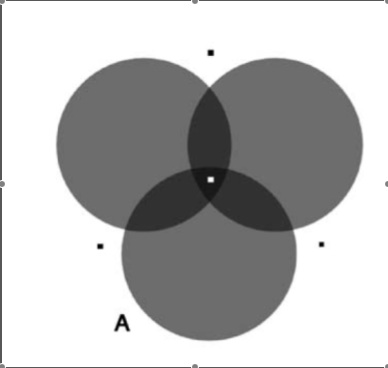
The NYU Mind and Language seminar has started up again with a really excellent line up. Last Tuesday I attended Ned Block’s session on his paper Attention and Mental Paint. I have seen a version of this before. The basic idea comes from figures like figure a below. if one fixates (stares) ate the center and, while keeping one’s gaze fixed, moves one’s attention to an individual disk that disk will appear DARKER. After a bit of practice one can DARKEN any disk one wants by moving one’s attention around. Go ahead, give it a try!

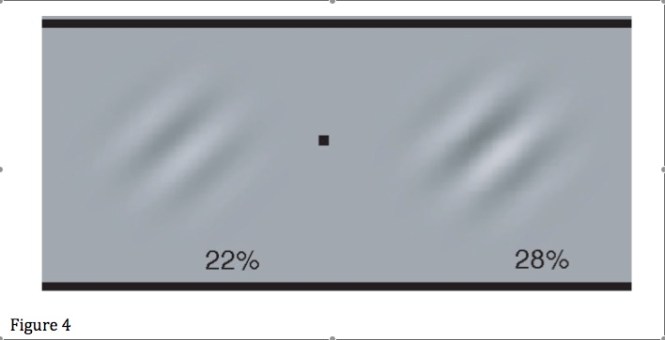
Recently a psychologist, Marisa Carrasco, has run experiments trying to quantify this effect. Below is a reproduction of the stimulus. Here the two patches differ in contrast by 8% yet when one fixates on the center and attends to the 22% patch one will judge it to be the same contrast as the 28% patch.


Block wants to use these findings as the basis for an argument against both direct realism and representationism. The basic argument goes as follows.

  • First we focus only on two cases. The first case is when we fixate and attend to the center. In that condition subjects get the judgment about contrast right (i.e. they judge that the left patch is lower in contrast). In the second condition we fixate on the center but attend to the left patch. In that condition people get the judgment incorrect (i.e. they judge the two patches to be the same contrast.
  • The second step is his claim that there is no reason to think that either of the two cases above are illusionary. Both are veridical.
  • If both experiences are veridical then the thing that they are experiences of must differ in some property but all of the properties of the objects are the same. The only thing that has changed is that one has moved one’s attention from center to right.
  • Therefore there must be mental paint, or non-representational features to our experience (the anti-representational conclusion) or a mental aspect of mental experience (the anti-direct realism conclusion)

a lot of the discussion at the session focused on whether or not there was an illusion at work here. Block claims that in both cases talked about above the perception is veridical. Why? His idea is that both of the experiences play the same functional role and so are accurate. The pro-illusion folk (Jesse Prinz was in this camp) argued that when you attend to something you represent that thing more veridically and so the condition where one fixates and attends to the center is illusionary (Jesse preferred ‘distorted’). Block protested that one could just as well say that attention distorted, or magnified, the scene and so the fact that one has access to more information when one attends is not by itself an argument that the experience is more veridical. Some other issues came up about various responses direct realists or representationalism could make.

However, I am less interested in that issue as I am in the issue of whether there is an argument here against anything like the kind of higher-order thought theory that I am fond of (i.e. one very much like David Rosenthal’s). On this kind of view we have two distinct kind of mental representations. At the first-order level we have the mental states that represent the sensible qualities. So, when I am seeing red I am in a mental state that has a property, call it red*, the represents physical red. However the kind of representation that is going one here is not intentional or conceptual. It is homomorphic. Red* is the property which is related to green* and pink* in a way that mirrors the relations between physical red, physical green, and physical pink. The starred properties can occur both consciously and unconsciously. When they occur unconsciously there is nothing that it is like for the organism in which they occur. They become conscious when I am aware of myself as being in a red* state. According to Rosenthal I do this by having a thought which deploys the concepts Red. So on this view the higher-order thought is representational in the traditional sense and it is the thing which is responsible for the phenomenology of the experience.

So is there mental pain on this view? Well, as long as one agrees that there can be unconscious sensory states with no phenomenology (a big step!) then Rosenthal’s first-order sensory qualities will count as mental paint. They are not intentional and they are mental. But they do not play a role in determining the phenomenology (except in the sense that we get the concepts we deploy in the higher-order thought from them) and so if we restrict ourselves only to conscious experiences it does look like Rosenthal denies the existence of mental paint. A conscious experience of red is constituted by a ‘I am seeing red’ thought which is completely intentional/representational. So then does Ned’s argument cut any ice against Rosenthal’s account of conscious experience?

It is not clear that it does. Ned’s argument gets its force from the claim that the thing being represented would have to be different because all conscious experiences are or represent just the actual properties that the object actually has. But on Rosenthal’s view we have the first and second order mental states. So, one could hold that there is some change in the first-order representation of the two patches or one could hold that the first-order representations are the same in the two cases and what changes is the way in which we are conscious of them. In talking briefly about this with David he seems to think that attention changes the first-order state whereas I seemed to think it was teh content of the higher-order state which changed. But since we are talking about conscious experiences here and it is the higher-order state that accounts for the conscious phenomenology the difference has to be in the way that we are conscious of the patch in the two cases…this may be because of attention in a causal sense but it is the content of the higher-order state that has to account for the difference in the phenomenology.

Cognitive Phenomenology

(cross-posted at Brains)

Via David Rosenthal-

There was a conference entitled “Theory Of Consciousness In Analytic Phenomenology And Philosophy Of Mind,”

at the University of Bern, Switzerland, May 27-29, 2009.

Podcasts of the talks are, for the next 2-3 years, at

https://cast.switch.ch/vod/channels/g3bo2419i

Talks are by David M. Rosenthal, Gianfranco Soldati, Andrea Borsato, David Woodruff Smith, Eduard Marbach, Sebastian Leugger, Dan Zahavi, Uriah Kriegel, Michelle Montague, and Galen Strawson.

The program is at

http://www.philosophie.ch/events/esap/es_single.php?action=date&eventid=299

I only listened to David R, Uriah, and Galen’s talks and the sound quality is a little uneven, but there is a lot of interesting stuff here…well worth the listen….

This is something that I am very glad to see. I am definitely one of those who thinks that cognitive phenomenology is real (and I think David Rosenthal is committed to it so it was interesting to hear him at this conference) though I don’t think that my view is the standard one. I, like Strawson, want to distinguish between the traditional kind of externalist content (though I, like Devitt, also allow inferential content) and the cognitive phenomenology. I take the cognitive phenomenology to go with the mental attitude that we take towards the traditional content. Let’s take belief, desire, and intention. These are the basic kinds of cognitive mental attitudes (whether there are more or if all other reduce to combinations of these three is a contentious issue…I take no stand on that here). Each one of these is really the name for a family of mental attitudes. So for belief we have a range between complete skepticism to mild doubt to probably true to complete certitude. What these have in common is a subjective sense of confidence as to whether something is actually true. To believe that p is to be subjectively certain that p is true, or to be convinced that p is true. Likewise, to doubt that p is to be subjectively uncertain that p is true. Likewise to want something is to have a subjective longing for it and to have an intention to A is to feel subjectively resolved to do A.

This explains all of the relevant data; for instance one main line of evidence for cognitive phenomenology is the experience that one has when one understands a sentence in a language one speaks. I agree that there is something that it is like for the person who understands a sentence of English but I claim that this is the result of the person coming to have some conscious mental attitude held towards the traditional content. So, when Galen tells me that the Earth weighs four times more than the Moon, I might feel surprise and wonder whether that were really true. Of course one might just ‘entertain’ the content but even here one take a qualitatively neutral mental attitude towards the content. This also allows us to explain why it is so many people dismiss cognitive phenomenology. Since my belief that 2+2=4 and my belief that New York City is on the East Coast of the United States of America are both things that I take to be beyond dispute they will feel subjectively similar when I introspect. Since I am looking for a phenomenological difference between the two thoughts I overlook their similarity. Interestingly this is supported by the reports of some schizophrenics who say that they can distinguish their delusional beliefs from their ‘normal’ ones by how they feel.

What then are we to say about unconscious beliefs, desires, and intentions? My claim is that conscious beliefs are just are the beliefs which we are conscious of ourselves as having and so is a higher-order view about consciousness. To have a conscious belief that p if just for one to have a higher-order state to the effect that one believes p. One feels subjectively certain about P just because one is conscious of oneself as believing P. When the belief is unconscious I have the same mental attitude held towards the traditional content but I am no longer conscious of myself as believing it and so there is nothing that it is like for me to believe it. I think that we can at this point give a homomorphism account of the mental attitudes. The mental attitudes come in families and there will be similarities and differences between these families that preserve the similarities and differences between the illocutionary forces of utterances used to express the mental attitude+traditional content…but that is another story….